Healthy Trees Begin Beneath Our Feet
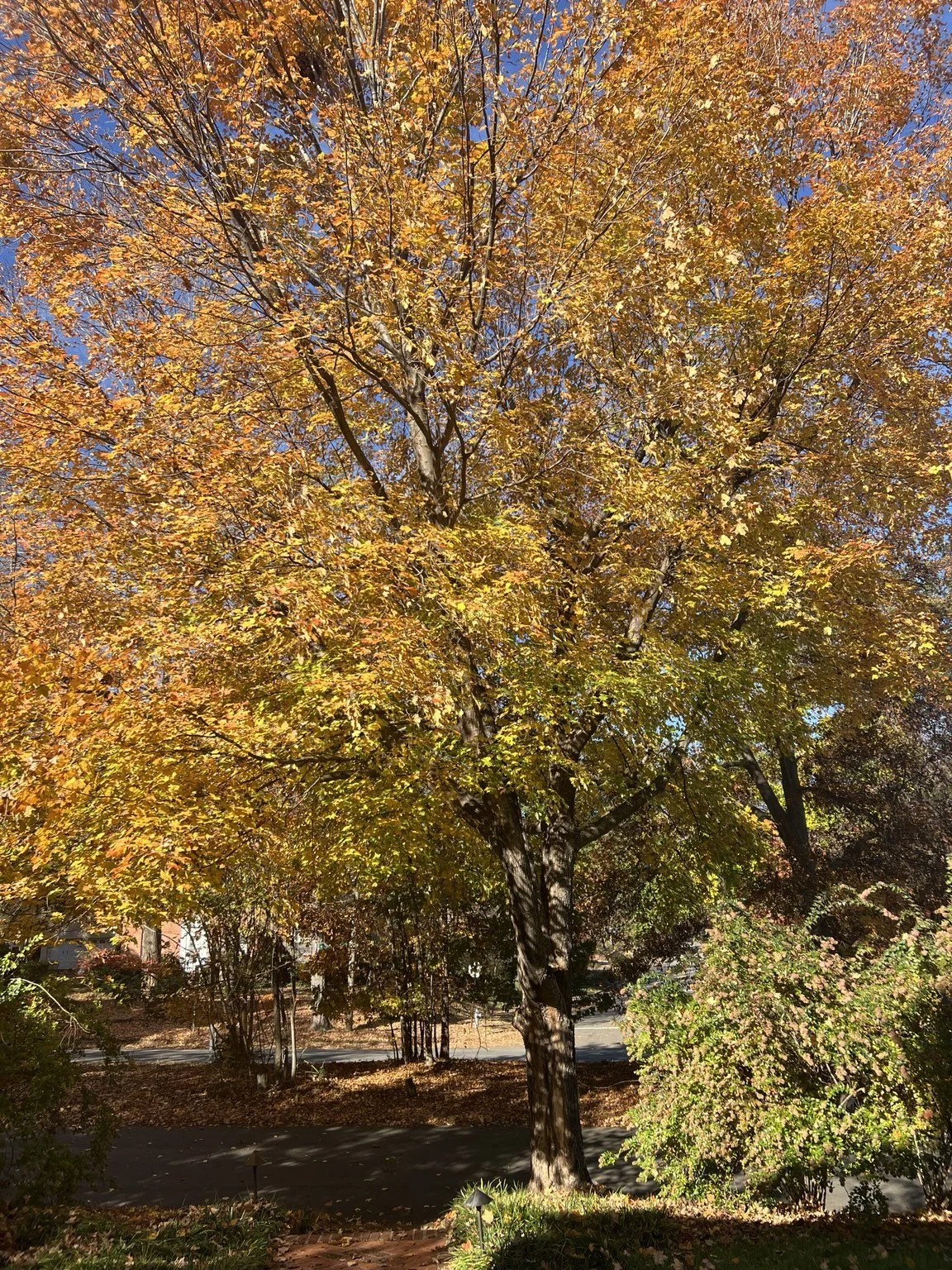
What a magnificent Westover Hills Maple Tree taught me about the living soil beneath our gardens…
When we think about the beauty of trees, we naturally look up. Right now in Richmond, walking and driving, we are seeing the glorious golden Ginkos, Red and Orange Maple Trees, and the myriad notes of Fall color in our neighborhoods.
Just outside my home in Richmond’s Westover Hills neighborhood stands a magnificent mature Maple. Each autumn, its canopy turns a glorious golden orange then yellow, illuminating the street and reminding me how fortunate we are to live among such beautiful trees.
This Maple grows in a narrow strip of soil between the road and sidewalk. I enjoy it in all seasons as our walkway steps right past the trunk. In Fall, she is in her glory (I think) and welcomes the season like no other.
Over the years, its roots have pushed upward, lifting sections of pavement as they search for room to grow. And yet, despite these challenges, it continues to grow, offering shade, beauty, and habitat for wildlife.
I often think our urban trees are nothing short of miracles. They give so much to us…cooling us in the heat of the summer, turning exhaust into oxygen, and respite for birds and people in our urban communities. Recently, I attended an event that helped me understand just how important the world beneath our trees really is.
Healthy Soil, Healthy Trees
As a member of the advisory board of Capital Trees, I had the pleasure of attending Healthy Soil, Healthy Trees, a community event presented in collaboration with Bartlett Tree Experts.
Our guest speaker was Dr. Glynn Percival of the Bartlett Tree Research Laboratory in Charlotte, North Carolina. With a fascinating background that includes caring for royal trees in England, Dr. Percival brought an impressive depth of scientific knowledge and a wonderful sense of humor to a subject that can become quite technical!
His presentation explored the science of soil health, the challenges facing urban trees, and the many products available to improve growing conditions. What stayed with me was a surprisingly simple idea:
Before we can improve our soil, we need to understand what it needs.
Soil is the Soul of our Gardens
Soil is a living ecosystem. I like to think of soil as the soul of the garden, or the essence of where all life begins. Like broth for a good soup, without good soil, your garden recipe is going to struggle to thrive. An urban tree needs good soil soup.
What makes a good, yummy soil? Beneath our feet is an extraordinary community of fungi, bacteria, insects, and other organisms that help recycle nutrients, break down organic matter, and support plant life. Healthy soil also needs something we don’t often think about: space.
The tiny openings between soil particles allow water and oxygen to move through the ground and provide room for roots to grow. When soil becomes compacted through construction, heavy equipment, foot traffic, or years of disturbance, those spaces become smaller.
What happens with less room to grow? Roots struggle to grow. Water may no longer drain properly. Oxygen becomes less available. Even if the soil contains plenty of nutrients, the tree may be unable to thrive.
This is particularly important in urban environments, where mature trees often grow surrounded by sidewalks, driveways, buildings, and compacted lawns.
A Tree’s Remarkable Gift to Itself
One of the things I find most beautiful about nature is how little is wasted. The tree is a closed-loop system, giving itself exactly what it needs each season to store energy for the next.
Each Autumn, our Maple Tree releases the leaves that have spent the growing season capturing sunlight and helping produce the energy it needs to grow.
Those leaves drift to the ground, creating a protective blanket over the soil.
Beneath that blanket, an extraordinary community of fungi, bacteria, earthworms, and other organisms begins the quiet work of decomposition.
As the leaves break down, nutrients are returned to the soil, organic matter accumulates, and the conditions that support healthy roots are renewed. I find something profoundly beautiful about this.
A tree produces the very leaves that will help nourish the soil beneath it.
In a sense, it is participating in its own care, creating the conditions that will help sustain future growth. There is something almost maternal about this cycle of giving and receiving, a natural form of nourishment that reminds me of the way a mother sustains her child.
Of course, the tree isn’t doing this work alone. It is supported by an entire living community beneath the soil, each organism playing a role in transforming fallen leaves into nutrients and organic matter that support future life. The tree, its roots, the microorganisms, and the soil are all connected in a remarkable cycle of renewal.
What we sometimes think of as garden debris is actually part of an extraordinary system of nourishment. And every Fall Season, nature offers us another opportunity to protect it.
Diagnose Before You Treat
One of the most interesting lessons from Dr. Percival’s presentation was that not every soil problem can be solved by adding something to it.
We have an extraordinary range of products available today…compost, fertilizers, biochar, beneficial fungi, and various soil conditioners. Some can be quite useful. But their effectiveness depends on understanding the problem we’re trying to solve.
-If a tree is struggling because its roots cannot get enough oxygen, adding fertilizer won’t correct the problem.
-If the soil is poorly drained, adding nutrients won’t necessarily improve the growing conditions.
-And if the soil is already healthy, additional treatments may offer little benefit.
A soil test can help identify chemical concerns such as pH and nutrient deficiencies. But understanding soil health also requires looking at physical conditions, including compaction, drainage, and available rooting space.
In other words, we need to understand the soil before deciding what to add.
What About Compost, Biochar, and Fertilizer?
Dr. Percival reviewed a fascinating range of soil amendments, including some newer products receiving considerable attention. He offered charts and graphs to help us understand that there are MANY options, and the trees that benefited most were trees (mostly urban trees) that were already in dire straits.
So what worked best? Here is what he found:
-Compost and natural organic mulch stood out for their consistent benefits. They can help support soil structure, moisture management, organic matter, and biological activity. Easy and available on-site!
-Biochar was another interesting topic. Made by heating organic materials under limited oxygen, biochar is a carbon-rich material that can sometimes improve soil properties, particularly in degraded soils. However, its benefits depend on how it is produced, the type of soil, and how it is applied. A “new-to-me” kid on the block, I wanted to learn more.
- Fertilizer sounds great, but it isn’t a universal solution. When testing reveals a genuine nutrient deficiency, a carefully selected fertilizer can help. But fertilizing a tree growing in severely compacted soil won’t solve its underlying problem.
Overall, what I found especially interesting was that amendments may offer the greatest benefits where soils are most depleted or degraded…our urban trees.
So what Dr. Percival shared was that we had options, and to be more thoughtful about how we use them. Diagnose, then treat.
Bringing the Forest Floor Into Our Gardens
Whenever I think about healthy soil, I find myself returning to the forest. In a woodland, the ground is rarely bare. Fallen leaves, twigs, and decaying plant material create a protective layer that supports the living soil beneath.
Nature has a remarkable way of caring for itself when we give it room.
In our residential landscapes, however, we often remove every fallen leaf, maintain turfgrass right up to the trunks of mature trees, and work hard to keep the ground looking perfectly tidy. I completely sympathize with loving a tidy garden, and have made some adjustments over the years as I have learned more about the benefits and nuances of leaving some of nature’s gold where it falls.
At our own home, we try to leave as many of the fallen leaves as possible in the planting bed beneath it. It’s a small gesture, but one that allows some of the tree’s natural cycle of renewal to continue. We keep our pathways clear and move leaves off the lawn. Some are composted in a bin, some are left under the trees and under shrubs, and some are chopped up to spread in garden beds.
I am inspired by how nature does this on a forest floor. I love to walk in the woods near our house and started to notice that these trees are thriving without much input from me. Instead of a mess, I began to think of the rich broth I like to make with bones and vegetable scraps to nourish my body in Winter. The leaves have all the makings for that rich broth of soil under my feet. The soil is the soul of the forest, where everything I love begins.
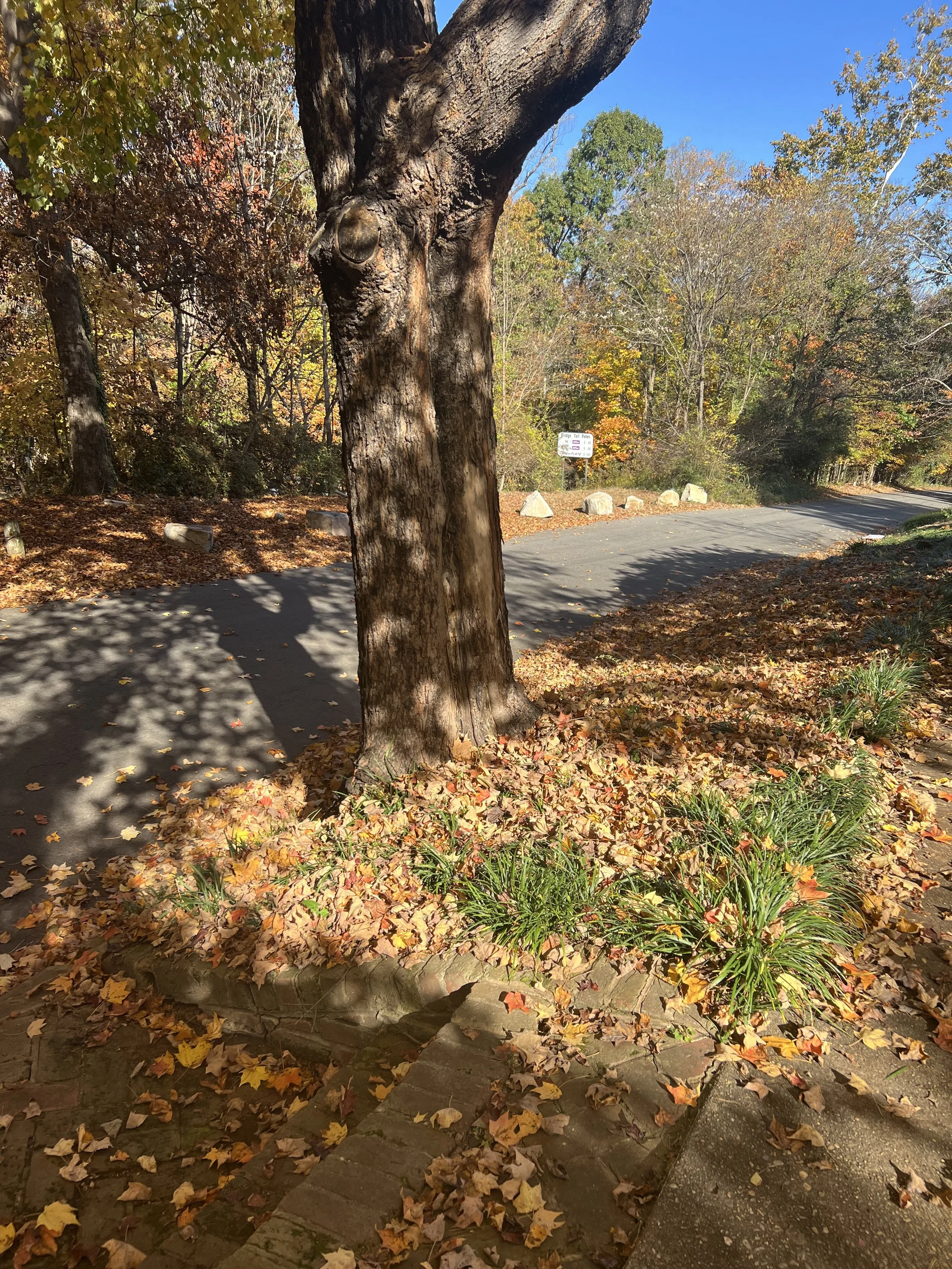
If soil is the soul of our garden, we can rethink what a beautiful garden floor would look like.
.
What if, instead of removing everything a tree gives us each Fall, we allowed more of those leaves to remain beneath its canopy?
What if we created generous planting beds beneath our trees, filled with appropriate native groundcovers, ferns, sedges, and woodland perennials?
What if we began to see fallen leaves not as something to clean up, but as a natural resource that our trees have already provided?
A thoughtfully designed landscape can incorporate these natural processes while still feeling elegant, intentional, and cared for…I am learning and evolving and growing too. I think that this is a relationship that will give so much back to you as you explore the nuances in your own garden and community. For me, this is where the principles of classical garden design and ecological stewardship come together.
A garden can be both beautiful and beneficial, with thoughtful structure above ground and a thriving living ecosystem below.
Five Ways to Support Healthier Soil at Home
1. Protect the roots of existing trees.
Avoid unnecessary digging, heavy equipment, and repeated traffic beneath mature trees. Their roots often extend far beyond the canopy. Protecting the soil around them is one of the most valuable things we can do.
2. Let trees keep their leaves.
Each Autumn, trees provide a natural resource for the soil beneath them. Allowing fallen leaves to remain in planting beds helps protect the ground, support soil organisms, and recycle nutrients. Think of those leaves not as waste to be removed, but as part of the tree’s own system of renewal. Keep heavy accumulations off lawns and away from tree trunks.
3. Mulch thoughtfully.
Where natural leaf cover isn’t practical, use wood chips or shredded leaves to protect the soil surface, conserve moisture, and moderate temperatures. Keep mulch away from the trunk and avoid piling it too deeply.
4. Pay attention to drainage and compaction.
Notice where water collects, where soil becomes hard, and where trees may have limited rooting space. These physical conditions often deserve attention before adding amendments. Established tree roots should be protected during any soil improvement work.
5. Test before you fertilize.
A soil test can help identify nutrient deficiencies and pH problems. For established trees showing signs of decline, a qualified arborist can help assess the larger picture, including root health, drainage, and soil structure.
Caring for the Trees We Already Have
Here in Richmond, our urban forest is one of our greatest treasures. Our mature trees shade our streets, provide habitat for wildlife, cool our neighborhoods, and connect us to the history of the places we call home.
Organizations like Capital Trees play an important role in helping our community understand the value of these living resources. And while planting new trees is essential, caring for the magnificent trees we already have is just as important. At Capital Trees, we are committed to caring for public greenspaces, nurturing existing trees, and planting trees for future generations. We would love to have you join us!
I’m grateful to Capital Trees, Bartlett Tree Experts, and Dr. Percival for sharing this important conversation with our community. As a landscape designer, I am always looking for ways to bring together the beauty of traditional garden design with the ecological benefits of a living landscape.
When I look at our Maple now, I see more than its magnificent branches and golden autumn leaves. I see the remarkable living system beneath it, quietly working to sustain this beautiful tree. Our role isn’t always to improve upon that system, but to understand it, protect it, and give it room to flourish.
What if the most valuable thing we could give a tree is something it has already given us?
Beautiful and Beneficial.
— Wendell Welder Landscape Design
